.webp)
PPC and the Rise of AI Shopping Agents (And What You Can Do to Prepare!)
Hey there, PPC folks. Let’s talk about AI agents. Heck… let’s talk about AI and Ecommerce.
I was watching a podcast not too long ago (shoutout to Diary of a CEO, watch the episode here). It featured an interviewer and several leaders in the AI field. At the beginning of the episode, the interviewer uses an AI agent to order bottles of water for the entire room with a simple prompt:
“Please order me 4 bottles of water to (address redacted). Make all the decisions. Give a 20% tip. And use any card you have on file for me for payment. Choose whatever water will arrive soonest.”
The AI agent works for a few minutes, and later in the episode an Uber Eats driver arrives with the water.

Being in the field of digital marketing, this got me thinking: how are AI agents affecting, and how will they continue to affect, our lives in the e-commerce space? Specifically in PPC marketing and Google Ads?
According to a January 2026 report from Adyen, 35% of U.S. shoppers are already using AI assistants (LLMs or Agents) to buy products. Over half of them are completely comfortable letting the AI handle the entire checkout process. On top of that, the vast majority of retailers, 88%, are open to enabling AI to complete purchases on the shopper’s behalf, with 56% prioritizing this technology for the year ahead.
Forget making six-fingered pictures. People really just want robots to do their chores, including spending their money online.
I’m here to warn you and maybe be a little prophetic. The classic model of typing a keyword and clicking a text ad is fading fast.
How the Machines Do Our Bidding
Here is a painfully simple breakdown of how a tech-savvy person might buy a home office setup using an AI agent today.
Step 1: The Lazy Prompt
The user opens their AI assistant and types exactly what they want:
“Find me a standing desk and a nice chair under $1,500 that ships to my hometown by Friday.”
Aside from confirming the purchase,the human is officially done working.
Step 2: The Data Dump
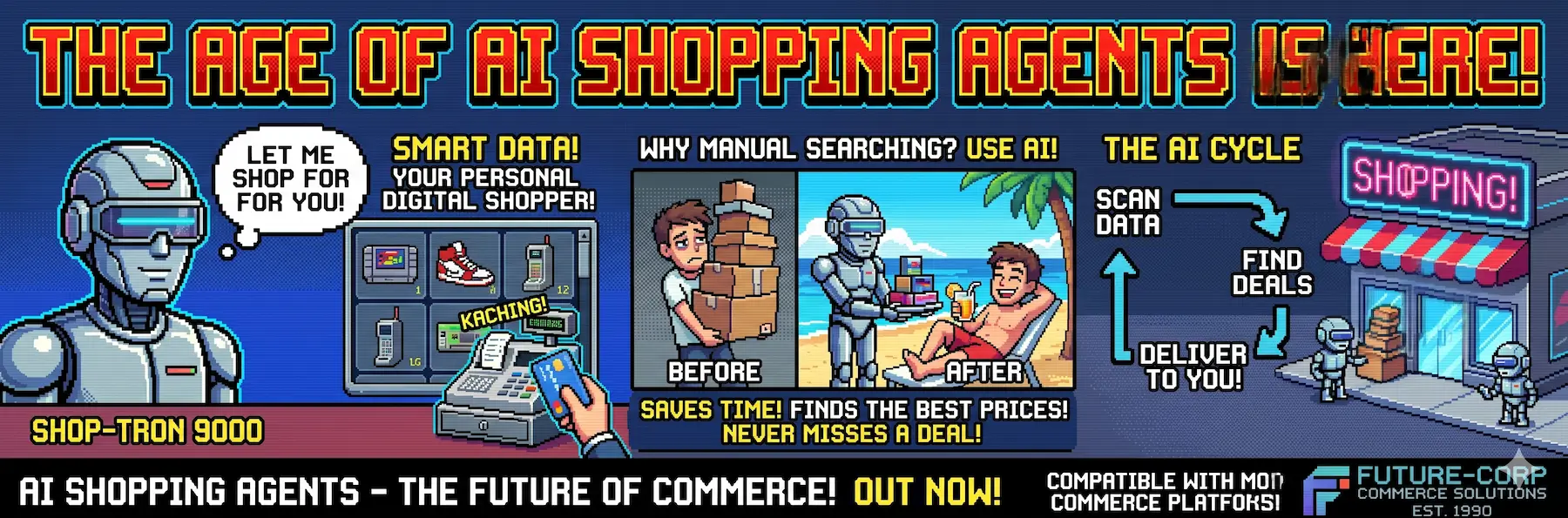
The AI agent scans the data of thousands of products instantly. It checks product descriptions, inventory, ZIP codes, and reviews to find the perfect match.
Step 3: The Neat Little Basket
The agent spits out two or three perfect options. Doom-scrolling through fifty pages of desk chairs is officially dead.
Step 4: The Robot Checkout
The user says, “Buy the first one.” The AI uses the person’s saved credit card and talks to the store’s API to purchase the items. A robot just bought a chair for a human to sit in.
Step 5: The Aftermath
If the desk arrives broken, the user tells the AI to return it. Your personal bot will literally argue with the store’s customer service bot to get a refund.
The Data-First Shopper
AI agents act like researchers who skip the flashy stuff. They focus on the product facts in your Google Merchant Center feed. They look for specific details like answers to questions or compatible parts. Google even has Direct Offers (more on that below) to give these agents a discount at the right time. If your data is missing details, the AI agent simply moves on to the next option.
Machine to Machine Bidding
We are entering a world where Google’s advertising AI negotiates directly with a consumer’s personal AI. It is literally computers talking to computers to spend human money.
So what do we as PPCers do with this information?
How do we set up Google Ads accounts so the robots actually pick our clients?
Beef Up Your Merchant Center Feeds
The single most important thing is this. The more data your feed has, the more data an AI agent can use to find the exact product a consumer is looking for. Give them every spec, material, and shipping time you have. An AI with incomplete information will simply drop your product from the evaluation.
Get Ready for Direct Offers and UCP
Google is rolling out features that allow you to offer exclusive discounts straight to the AI when the user is ready to buy. Set these up so your bot can close the deal automatically.
You also need to look into the Universal Commerce Protocol (UCP). It is a totally wild new open standard for agentic commerce. UCP creates a common language for agents and systems to operate together across the entire shopping journey. This protocol will soon power a new checkout feature on eligible Google product listings in AI Mode. Shoppers will literally be able to check out right from Search and the Gemini app using Google Pay. Retailers remain the seller of record and can easily customize the integration to capture sales. It is going to make agentic checkout super smooth.
In fact, this entire article is a great read if you want to see what Google is doing to stay ahead of the AI Shopping Agent game:
https://blog.google/products/ads-commerce/agentic-commerce-ai-tools-protocol-retailers-platforms/
Simplify Your Campaign Structure
Of course, this isn’t advice for every single account. Do what works best for your business. But remember, this is not a human searching for a specific item. Machine learning needs a massive amount of data to work.
When a consumer’s shopping robot eventually comes looking for a desk with a very specific set of requirements, your fully trained Google Ads AI (thanks PMax) knows exactly how to negotiate. It has the confidence to bid aggressively and win the placement. It has the historical data to prove your product is the mathematically optimal choice.
This is how a robot talks to a robot.
Feeding The Machine Good Data Is More Crucial Than Ever
It is crucial to make sure that your conversions and real values are accurate. With bad data comes bad learning.
To Conclude:
I originally wrote this post a few months ago. It was more “food for thought”. Maybe even a prediction? Witchcraft? In just that short amount of time this has become more and more a reality. At least that’s where the ad platforms are leaning.
As digital marketers, we need to keep our ears to the ground for any new technology that might change our industry. Be on the lookout for AI agents in your data and adjust accordingly.
We know that the brands with the cleanest data are going to win. (hasn’t this always been the case?)
The robots will simply ignore everyone else.