.webp)
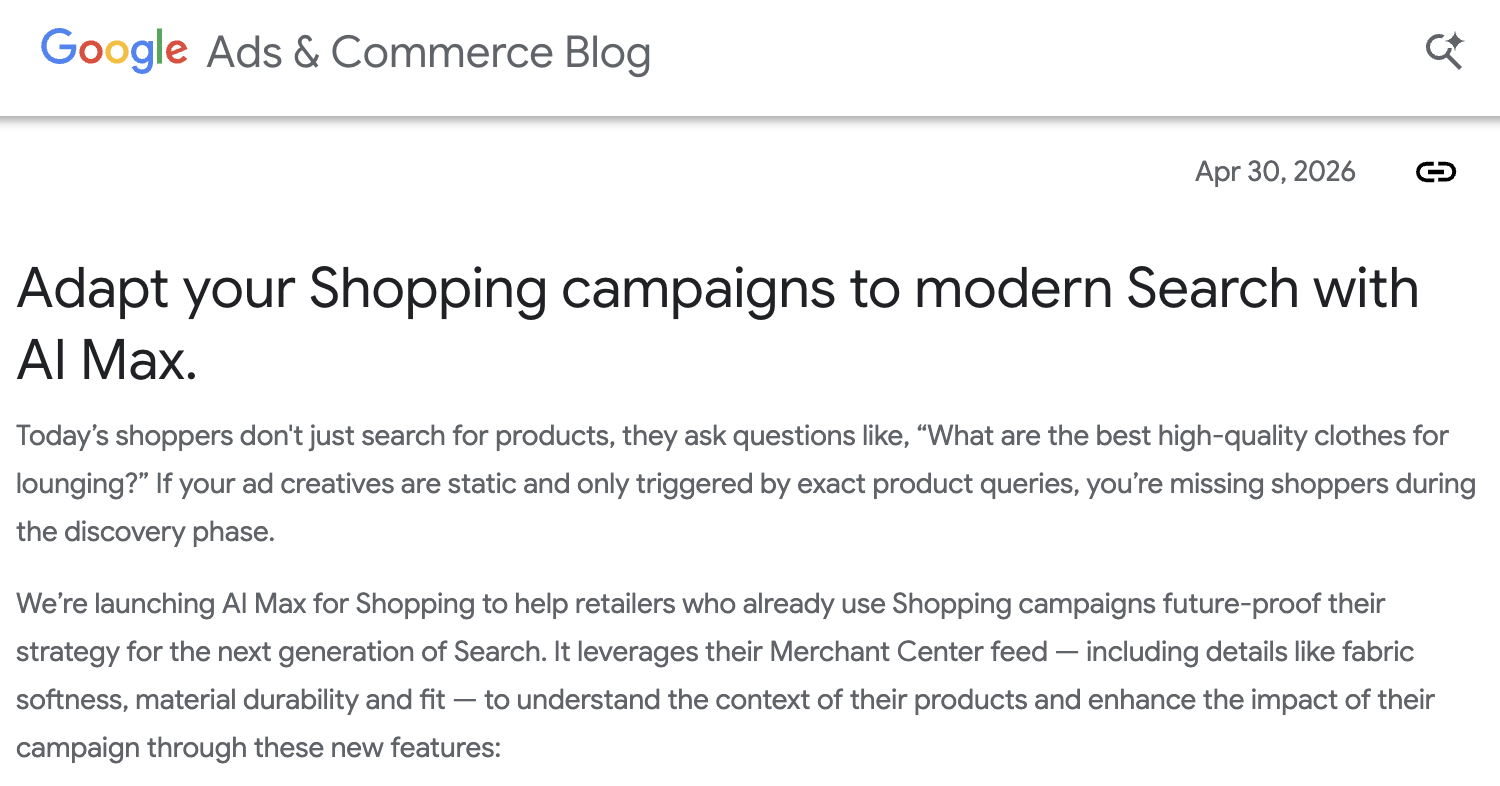
On April 30th, Google announced the newest feature in their AI-optimized lineup: AI Max for Shopping. While we've written on this before on the ZATO Blog, specifically when ZATO Owner Kirk introdued his thoughts on how AI Max for Shopping could incorporate into a new way of organizing your Google Ads campaigns).
But what exactly is AI Max for Shopping and how does it differ from AI Max for Search?
If you are currently utilizing Google’s standard shopping format alongside your Performance Max campaigns, this feature will be most helpful to test as it is currently only available within standard shopping campaigns as Performance Max already uses some of the same components in its original iteration. AI Max for Shopping introduced three new features to your standard shopping campaigns: text customization, final url expansion and optimal format selection. Let’s go into these one by one.
Text customization
If you’ve run Pmax or AI max for search, you will be familiar with this already. Text customization in AI Max for Shopping essentially generates ad copy for your shopping ads (note: the shopping format) so that they speak directly to shopper intent and conversational queries. This is very important, as this means that Google is no longer pulling your shopping titles from your product feed, but is dynamically changing them to speak to the user’s query. My question for Google is: will this make title optimization obsolete? Additional testing will have to be done to say so, but this may level the playing field for those advertisers opting in.
Optimal Format Selection
This one is new. Google will decide whether or not to surface the shopping ads format or text ads. This means that your shopping ads are potentially serving across search as well as shopping. We would expect to see some overlap if you are also targeting some product-based keywords in your search campaign as well.
Final URL Expansion
Final URL expansion is also similar to what we see in Performance Max. Here, Google will match out to your site’s most relevant landing page, based on the shopper’s intent. This will only serve in the instance that the selected format is text ads and not the shopping ad format. The ability to serve across final url expansion can be turned off, which will also turn off optimal format selection and only serve across the shopping ad format.
AI Max for Shopping brings a significant change to standard shopping campaigns (though according to ZATO owner PPCKirk Williams, he believes this is basically a refresh of Google’s Smart Shopping Campaigns, the pre-cursor to PMax!) by introducing three core AI-driven features: dynamic text customization to match shopper intent, optimal format selection for wider ad surfacing, and final URL expansion to land users on the most relevant page. For advertisers currently running standard shopping campaigns alongside Performance Max, testing AI Max for Shopping will be a great test to leverage this AI-optimized experience. While questions remain about the future of manual title optimization, the feature could level the playing field and dynamically adapt ads to conversational queries. It’s another move Google has made towards an increasingly large lineup of AI-centric campaigns and only time will tell how it performs or how it is received.