.webp)
The AI Competency Gap in PPC Nobody Is Talking About
Something has been bothering me for a few months, I've written about it a bit in different ways, had some great LinkedIn conversations... and I think I've finally worked out how to say it clearly.
So ready or not, here goes...
A lot of skilled PPCers are building impressive AI workflows right now: agentic processes, custom prompts, automated account analysis, smart systems that surface insights faster than any human could alone. And they're sharing it publicly, often with the attitude of "anyone can do this!!", which is a generous thing to do and a natural instinct in a community that has historically learned by sharing.
But there is an unintended consequence I think is happening: non-PPCers are seeing those posts and drawing a conclusion the original poster didn't intend.
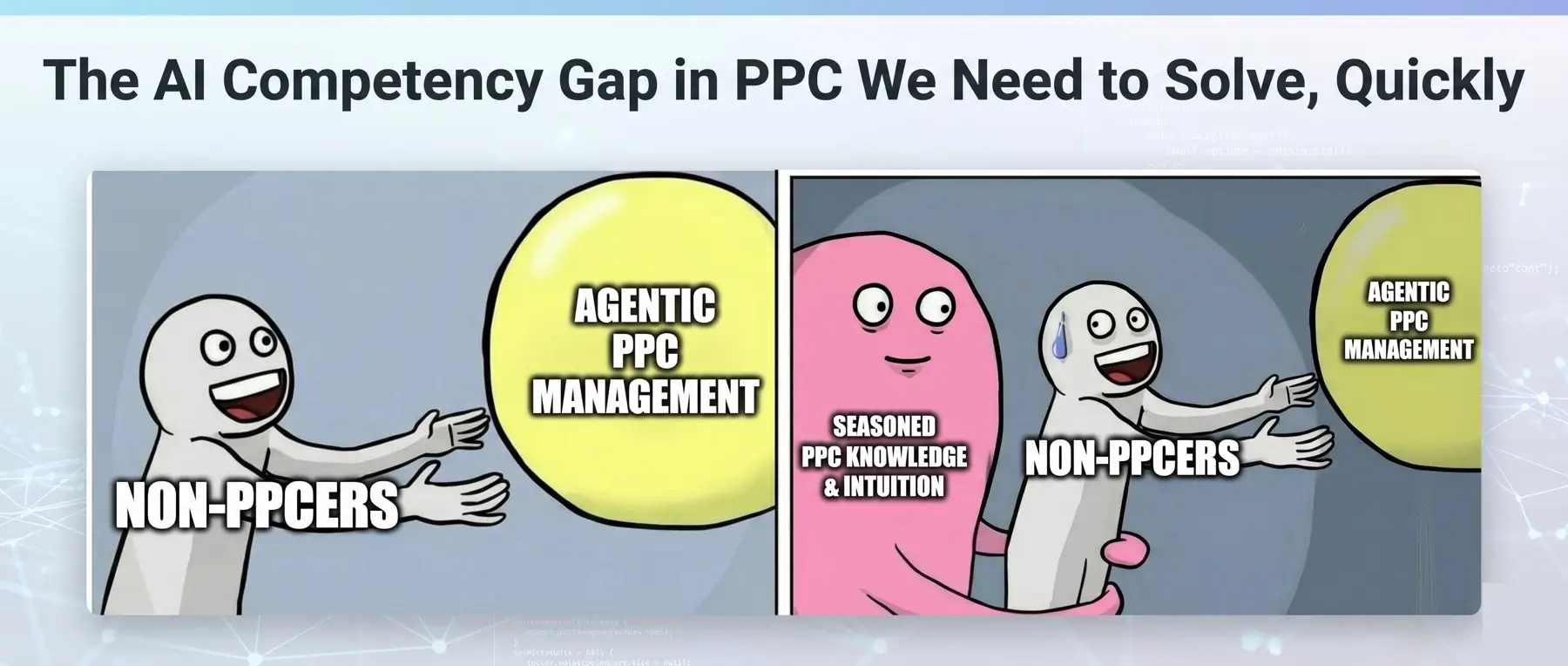
The conclusion goes something like this: "If an AI agent can do what this PPC professional does, then I don't need the PPC professional"
A brand operator recently posted in a forum (I am obviously keeping them anonymous, but I assure you this happened with a lot of responses from others wanting to do the same) that they were firing their agency and replacing them with Claude. They had been reading all about AI-powered account management systems and decided they could replicate it.
This is, I think, where most of my public caution about AI has been coming from, and I want to try to articulate it more precisely than I have before.
But let's start here, if they actually can replicate the exact service and performance they were receiving by running Claude themselves, why wouldn't they fire a professional??
The Misunderstanding at the Center of This
When an advanced PPC professional builds a successful AI workflow, the AI is not doing the advanced work. The professional is. The AI is accelerating and extending work that the professional already knows how to evaluate, correct, and guide. The expertise is still doing the heavy lifting. The AI is just moving faster.
Crucially: the practitioner knows when the AI's output is wrong. They know when a "recommendation" reflects a best practice that doesn't apply to this specific account's history. They know when a performance dip has a cause the AI can't see because that cause lives in a conversation they had with the client two months ago. They know when to push back on what the AI surfaced and when to act on it. They know when and how to set up a new guideline or guardrail after observing a concerning trend in the AI's output.
That knowledge isn't in the prompt. It's in the practitioner.
Strip out the practitioner and you don't have a faster version of what the practitioner was doing, you have an unsupervised probabilistic system making decisions in a live account with real budget and real consequences, operated by someone who doesn't have the expertise to know when it's going wrong. I wrote about the probabilistic side of this specifically in The Probabilistic Problem With Autonomous PPC Agents, but the competency gap is actually the more important piece of the puzzle.
When positive-AI public content doesn't carry caveats
I want to be careful here because I'm not criticizing anyone for sharing their work. The PPCers posting these AI workflows are not doing anything wrong. They're being generous with hard-won knowledge and that's admirable.
But I think what I've become more clear on, is that I believe there is a framing problem that tends to accompany this content, which is that it's often presented in a way that implies accessibility. "Here's how I audit accounts with AI." "Here's the prompt I use to analyze search term data." "Here's how I've automated X."
The implicit message, even when the author doesn't intend it, is "anyone can do exactly what I do."
The advanced PPC practitioner reading that post interprets it correctly: here's a technique I can add to my toolkit, evaluate with my existing expertise, and deploy where it makes sense. They have the filter.
The brand operator reading the same post interprets it differently: here's a system I can run instead of paying someone to do this work. They don't have the filter. And few are (yet, but we can change that now!!) telling them they need one.
This isn't hypothetical. I've been on the other end of this in conversations with clients who have come to us with AI-generated account audits produced by stakeholders without PPC experience (in fact, I've taken to calling these monstrosity's Claudits because of how unhelpful to the account and relationship they tend to be. The Claudits look authoritative. They're formatted well. They're confidently wrong about things that any experienced practitioner would have caught immediately, but only because that practitioner knows what questions to ask, what context is missing, and which "best practices" don't apply to this account's specific situation. I wrote about exactly this dynamic in Stop Running Your Google Ads Data Through Claude Until You've Solved These Two Problems.
The Problem With Making it a Habit of Saying "AI Isn't Dangerous"
So here's my personal experience at this point. When I raise concerns about AI usage publicly, I frequently get a version of this response from skilled practitioners: "But AI is life-changing, I use it all the time and it works great, you just need to understand how it works and utilize it correctly."
EXACTLY!!! We could not agree more, and it's why I'm writing this. We agree on two things here:
1) AI is great and can be life changing
2) AI must be used correctly in order to accomplish #1
Consider the response I shared (a composite of many many many responses from many people over the past 6 months), it is being made from inside a context of deep expertise. Of course it works great for experienced professionals in a specific field! They have the knowledge to run it well. They're evaluating outputs against years of pattern recognition. They're catching errors before those errors propagate. They are, essentially, the safeguard.
But when they say "AI is is life-changing" or "AI is awesome!" without emphasizing the caveat, they're not describing the experience of the brand operator who just fired their agency and pointed Claude at their Google Ads account with no PPC background and no ability to evaluate what's happening. They're describing their own experience, which is categorically different, and then broadcasting it to an audience that includes a lot of people who don't share their context.
So if you're reading this as a skilled PPC practicioner, I guess I'm asking you to consider: begin emphasizing the "when used well" part AS MUCH AS the "AI is lifechanging and here's how to use it" part in your courses, posts, blogposts, and podcast episodes.
Your skill and your experience is a crucial part of the story "here's how awesome AI is for me in managing Google Ads!" But what's true you for you is potentially false for them. Conflating those two situations can do real harm to real businesses. It's also, somewhat ironically, doing harm to the long-term credibility of PPC professionals as a category, as well as the tools themselves, because when some of those businesses inevitably get into trouble with poorly supervised AI, the story becomes "AI failed" or even "Google Ads doesn't work for me" rather than "expertise is still necessary and was removed." (BTW There is also a deeper concern which connects to something I've written about regarding liability: AI Agents in Ad Accounts: Why the Math Doesn't Work Yet. The financial and professional exposure from poorly supervised AI in live accounts is real, and it falls on whoever is ultimately responsible for the account.)
What I Think Advanced Practitioners Should Actually Be Saying
So in summary: I don't have a complete answer here. I'm not sure what the right industry-level response looks like. But I think the framing that would serve everyone better is something like: "AI in PPC is genuinely powerful, and running it well is a skill. If you don't have the underlying expertise, you can't run it well, and the consequences of running it poorly are real."
That framing does a few things. It's more accurate. It protects non-experts from making decisions that will hurt their businesses. And it actually preserves the professional value of the people sharing the content, because it makes clear that the AI workflow isn't the thing you can copy. The thing you can't copy is the expertise that makes the workflow work, in building it and in managing it over time.
The practitioner who shares their AI system without that caveat is, in some sense, handing over the appearance of their job to people who will then discover they can't actually do it. This is going to hurt you and them. The practitioner who shares their system and says "this only works because of what I know" is demonstrating why their expertise has value that can't be shortcut.
So I don't entirely know what to do with all of this yet. But I think naming it clearly is a better starting point than leaving the impression that anyone who reads a good AI thread can replace the person who wrote it.

.jpeg)