.webp)
In 2023 Google introduced the next iteration of Similar Audience lists in the form of Lookalike Audiences. However, while Similar Audiences could be used across all campaign types, Lookalike audiences could only be used as a targeting method when running a Demand Gen campaign. And while Similar Audience lists were automatically created by Google, Lookalike Audience lists required a bit more legwork. The way Lookalike Audiences are built are through a first party seed list. From there, you can choose a reach - narrow reach (2.5%), balanced reach (5%) or broad reach (10%). After doing this, Google populates your list and only shows ads to people within that specific similarity percentage. For example, the narrowest reach would only serve ads to users most identical to your seed list, the top 2.5% of people in your targeted country who share the closest behaviors, interests and demographics with your actual customers.
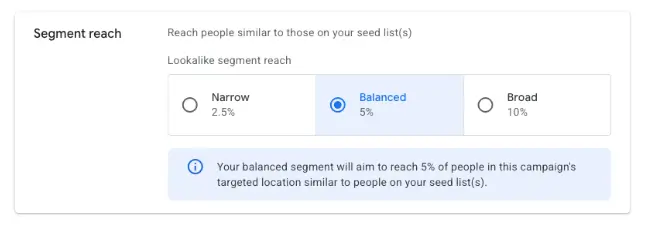
In February of 2026, Google made an easily missed announcement stating that how it views Lookalike audiences in a Demand Gen campaign will soon be changing. Instead of locking into a 2.5%, 5% or 10% similarity rate with your seed list, Google will now treat your seed list as a signal - allowing the bidding algorithm to find high value users who may not entirely fit the qualifications of a “lookalike,” but show high intent to convert. The slider scale used to create the original list is essentially deemed irrelevant.

There are pros and cons of this update. While giving you less control than the original iteration of Lookalike audiences, this does assist in preventing ad fatigue across your audience targeting and allows your campaigns to scale more effectively. However, you are no longer strictly targeting your lookalike audience - Google is now only using this audience as a signal.
Because of the new way Google AI is viewing Lookalike segments, Google strongly recommends they be used in conjunction with optimized targeting to work more effectively. Though, by doing so, you will also want to frequently review your audience segments and how much of your traffic is coming through optimized targeting versus your lookalike segments.
This is already happening in your account if you look within your audience reporting a see a signal tag next to your Lookalike lists. This indicates that Google AI is using them as a signal as opposed to strict targeting for your campaign. If you noticed a sudden jump in your Demand Gen reach or spend then that may have been this feature rolling out to your account.
If none of this sounds great to you, the good news is that you can opt out by filling out this form. If you opt out, your Lookalike segments will respect the reach target you’ve chosen when you created them.
Google’s announcement shouldn’t come as too much of a shock. It seems that most things in the Google-universe are moving away from strict targeting. If you do choose to adopt this particular shift, we recommend you pay close attention to all of the metrics within your DG campaigns to ensure that you remain profitable in the midst of it.