.webp)
Should You Fire Your PPC Agency and Replace Them With Claude?
I run a PPC agency, so let's just all agree right now that we all have biases, and there' s mine. In the remainder of this post, I'm going to caution you around firing your agency to use Claude, and my hope is that you'll at least hear me out... so let's start there, you don't have to agree with me, but could you promise to consider what I'm writing? Sometimes, biases get in the way of truth, but then sometimes (as I believe is the case here), biases actually come from a specific place. They come from us knowing the inner workings of a mechanism and cautioning singificant change to that mechanism. This is one of those cases (of the latter).
With that out of the way... the question is coming up constantly in ecommerce communities right now around the interwebz (agentic and human, I'm sure ;). Someone parts ways with their agency, they've linked Claude into their Meta and Google Ads accounts, and they're potentially saving several thousand dollars a month. Other operators read it and start doing the math. And the math is compelling.
What I want to do here is walk through some of the costs that tend to be underestimated in that calculation, because I think there's a version of this decision that makes a lot of sense and a version that quietly creates problems for months before anyone notices.
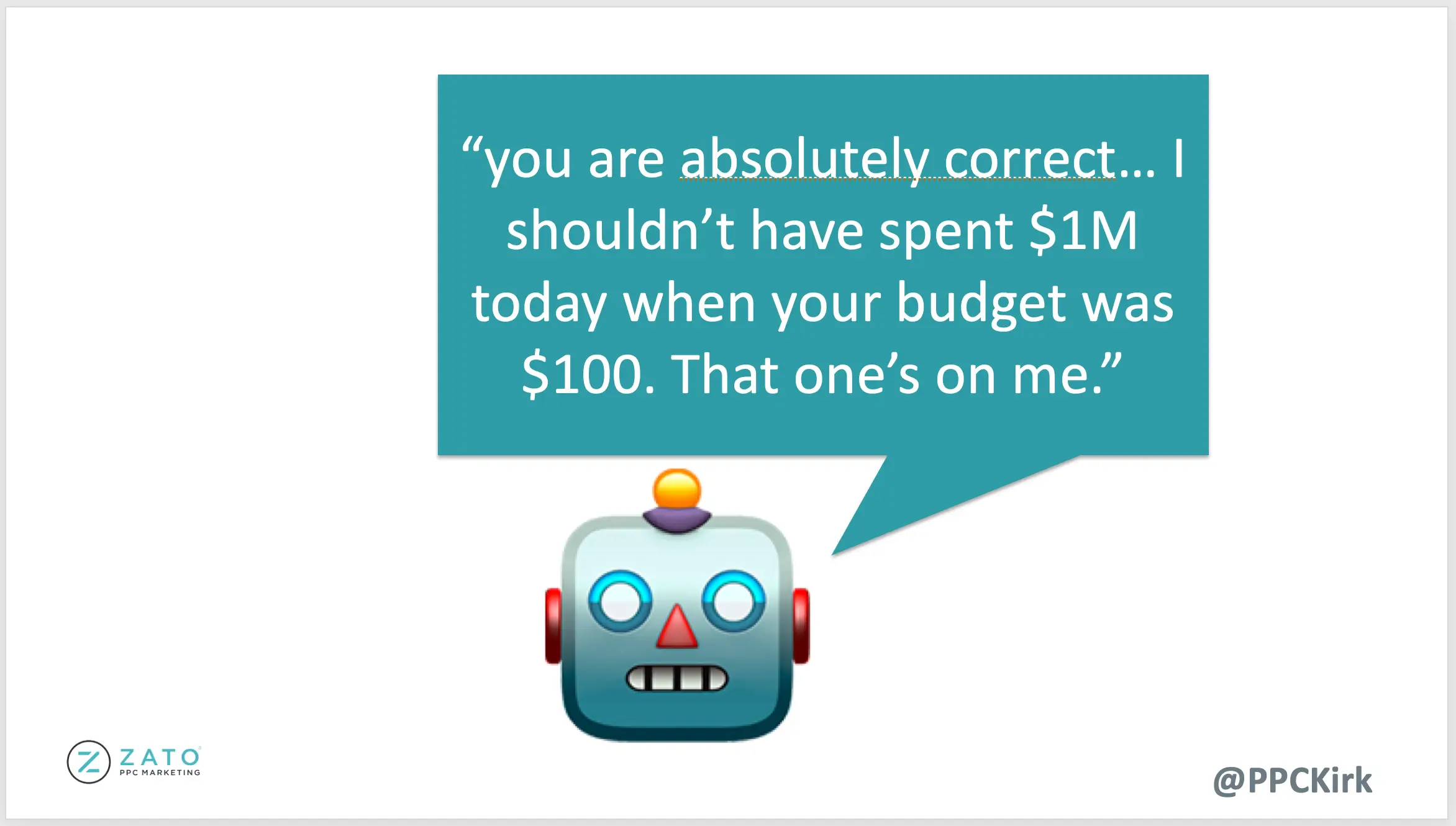
What concerns me the most, is that you may not even be aware that something is off the rails, until it has done quite a bit of damage to your pocketbook or online reputation.
From what I've observed, the difference usually comes down to a few things.
The First Question Before Switching to Claude for Google Ads Management
Before anything else, it's worth being specific about what you're actually building, because "replacing my agency with Claude" can mean two very different things in practice.
It might mean Claude as an advisor, where you're using it to analyze your account data, surface recommendations, and help you think through decisions, and then you're the one implementing the changes.
Or it might mean autonomous Claude agents that are connected to your ad platforms via API and are making changes directly, without you reviewing each action before it goes live.
Both are real setups, and both have advantages. But the risk profiles are different and deserve separate consideration.
Autonomous agents operating on live ad accounts can move quickly, which sounds great until a misfire in bidding logic or audience targeting starts burning budget before you've caught it. The blast radius on a bad automated decision in a Google Ads account can be significant, and it can happen quietly over days or weeks before it shows up somewhere you're looking. If you're going the agentic route, you need robust guardrails, change logging, and clear thresholds for escalation... and building all of that is itself a non-trivial project that takes real time and expertise to do well.
You're going to begin hearing a recurring theme through this post, and it is not that using autonomous agents to run your Google Ads is always a bad idea every time, it is: "have you adequately considered the actual time and energy and knowledge-gap cost to this switch"?
The (Suddenly New to You) Time Cost Is Real and Easy to Underestimate
Here's the framing that tends to get people into trouble: "Claude will handle it."
Claude won't always handle it. You will, with Claude as a tool. That's not a knock on Claude (genuinely impressive technology, for what it's worth coming from someone with a conflict of interest), it's just an accurate description of what AI-assisted account management looks like in practice right now.
I say "always" because, Claude will handle it sometimes (if you're utilizing autonomous agents)... and then other times you'll be handling it, and you never quite know when that will take up your time. But that's the reality of a business owner who doesn't delegate, isn't it? And again, this is the point I'm encouraging you to really consider in the depths of your bones: "are you wanting to take on the responsibility and time to begin managing a new section of your business that someone else was management" because using Claude, even fully autonomous, does. not. relieve. you. of. the. responsibility and energy of that aspect of your business.
Your agency was absorbing a certain number of hours per month. That work doesn't totally disappear when you switch to Claude. It transfers to Claude, but also to whoever is managing Claude.
In ongoing practice, that can look like:
- you're holding regular audit sessions where you're reviewing what Claude flagged against what's actually happening in the account and making the calls Claude can't make for you.
- You're iterating on your prompts and workflows when Claude's recommendations don't match what you're seeing (and you need to figure out why).
- You're doing pre-implementation reviews on bid changes, audience exclusions, and creative recommendations before anything goes live.
- You're debugging when your Meta API or Shopify data doesn't pipe through cleanly, because someone has to.
- You're jumping in to troubleshoot why something went wrong and how it went wrong and determining how to fix it.
- You're working to adapt to something that changed within Google Ads on the API, or markup, or a bidding models, or a million other small ways that Google may change things that will throw off an autonomous agent.
None of that is a dealbreaker. There are certain limitations in working with a human too, of course (though, not the responsibiltiy and ultimate culpability which also plays into the decisions we make in true professionals). But if the working assumption is that Claude replaces the agency while you focus on running your business, that assumption deserves a harder look. The honest question to sit with is: how many hours per week am I genuinely prepared to invest in this, and what is my time actually worth? For operators already stretched running a multi-million dollar ecommerce business, the real cost of "Claude costs almost nothing" can be higher than it appears in the initial calculation.
The Blind Spot Problem Is the One That Should Concern You Most
This is the risk that's hardest to see, literally by definition, because you don't see it until something has already been going wrong for a while.
Claude can only work with what you give it and what it knows. I think that creates two distinct vulnerabilities:
- The first is that you don't know what you don't know to ask. Good PPC practitioners carry a lot of what I'd call tacit knowledge, the kind of pattern recognition that never really makes it into a blog post or a training dataset because it's so contextual and situational. Things like recognizing when a ROAS number looks healthy but the underlying cohort data is masking churn. Or understanding that the right bidding strategy for your brand search campaign (tCPA vs. Impression Share with a CPC cap, for example) depends on your specific competitor landscape, your Quality Scores, and what stage of auction maturity you're at... not on what the top Google result says is the universal best practice. These aren't always things Claude will volunteer unprompted. If you don't know to ask the question, Claude won't flag the issue... and there are umpteen of these examples. Yes it's possible to train Claude over time to take on your knowledge and preferences (though, alarmingly, this is also saved in a database that can be magically and easily erased without, again, the proper know-how and safeguards), but my point above continues... this is a lot of work. If you are ready and excited about doing the work, at least I want you to walk into it with eyes wide open.
- The second vulnerability is that Claude's training data has a cutoff, and ad platforms move fast. Meta and Google change constantly: new campaign types, shifting smart bidding behavior, policy updates, auction dynamic changes that alter how you should be thinking about structure and spend. An LLM may be working from guidance that's twelve to eighteen months out of date while sounding completely authoritative about it, which is arguably more dangerous than obviously being wrong. Best practices that were correct last year can be actively counterproductive this year, and Claude won't know what it doesn't know. This is why, I do believe that a brand operator taking on the role of "Google Ads manager of Claude" must herself then commit to remaining up on changes in Platform knowledge and behavior and best practices... which again then begs the question, do you want to do this? Is it worth it for you? If the answer is "yes" to both of those, then great! Dive in and save some cash in the bank. But... just make sure you know what you're committing to.
What concerns me most is what happens when you combine both of these vulnerabilities. You and Claude can reinforce each other's blind spots over time without either of you realizing it. Attribution quietly breaks. A structural account issue compounds. ROAS looks fine on the surface while something underneath is drifting in the wrong direction. The scary part, I think, isn't what you know you're missing. It's what neither of you thinks to check.
What I Actually Think Makes Sense
None of this is an argument against using Claude for PPC work. I do believe it can be a powerful layer in how accounts get managed, and the operators who figure out how to use it well will have a real advantage.
What I'm more skeptical of is the framing that the agency's work simply disappears, that Claude handles everything, and that the only new cost is the API bill and "some of my hours". I think the more accurate version of the calculation includes the time cost of managing Claude week to week, the knowledge overhead of staying sharp enough to catch its errors and hallucinations, the risk of blind spots that compound quietly over time, and the infrastructure investment if you're building agentic workflows rather than advisory ones.
The model that seems most sensible to me (though I could be wrong about this, and I'm obviously not a neutral party) and what we are actively building at my business ZATO PPC Marketing Agency is something like: Claude handles the analytical and audit-heavy work, and a senior, ads specialist human stays close enough to the account to catch what Claude can't see. The economics of that arrangement are probably better than a full-service retainer for a lot of operators, and it's a more transparent accounting of what you're actually signing up for.
If you've thought all of this through and it still makes sense, I genuinely do wish you good luck with it! This space is moving fast and I'd love to hear what you find. I just want to make sure the map matches the territory before you set out.


.jpeg)