.webp)
In August, Microsoft launched its iteration of AI Max within Search campaigns. Intuitively, it is very similar to how AI Max within Google operates, though there are a few key differences.
What is Microsoft AI Max?
In addition to sharing the same name, Microsoft’s version of AI Max uses the same three key pillars that Google has within its version: search term matching, text customization and final URL expansion. The definitions are quite similar as well. Search term matching uses keywords, ads, landing pages and other signals to uncover relevant searches - including conversational queries that it incorporates into its CoPilot answers. Text customization uses existing assets and website content to generate and test additional messaging variations. Finally, Final url expansion routes people to the page on your site that best matches their intent. Microsoft explains these features in greater detail on its blogpost on the feature here. Microsoft is also launching AI Max with Brand Inclusions, Brand Exclusions and Text Guardrails - similarly to the features within Google Ads.
What Reporting is Available for AI Max in Microsoft?
Reporting for AI Max within Microsoft is available immediately as well. Within the search term report of AI-Max opted in campaigns you will see AI optimized search term match types. You can also see performance of AI Generated Assets in the asset report as well as Final URL expansion performance within the search term landing page report template.
How does Microsoft's AI Max Differ from Google's Version?
Though Microsoft's AI Max contains the same main things that Google contains in its version, the key differences remain in the separateness of the two platforms. Microsoft operates in an entirely different ecosystem than Google. Your AI Max campaigns will be integrated into Bing Search, Yahoo, AOL and CoPilot answers. Likewise, the search term matching component is driven by Microsoft AI, as opposed to Google’s Gemini. Microsoft also has the ability to utilize data it obtains from LinkedIn profiles in its query matching - making it especially useful for B2B queries. Lastly, Microsoft has also indicated that AI Max will not be a replacement for DSA and that standalone DSA campaigns will continue to be able to be created within the Microsoft platform.
How do I Implement AI Max in Microsoft?
Implementing AI Max within Microsoft is roughly the same as implementing it within Google Ads. You can also import a Google Search campaign with AI Max enabled to accomplish this as well.
Go into the campaign settings within Microsoft. The AI Max controls are located directly underneath the budget section.
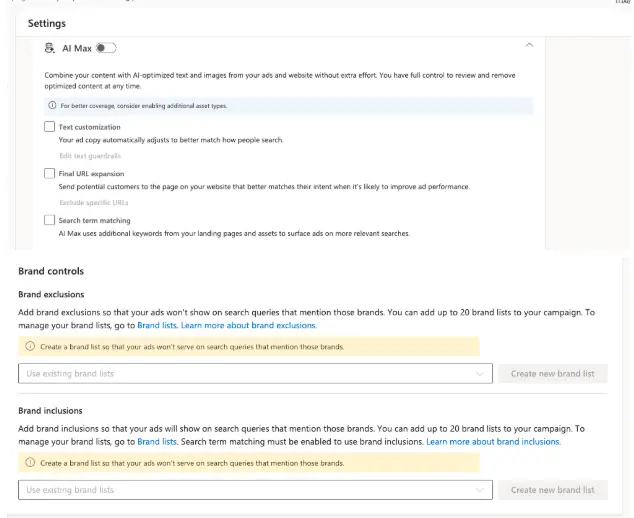
From here you can toggle on AI Max and the other features. Text Customization and Search Term Matching can be used independently of each other, however, you must have text customization enabled to utilize Final URL Expansion.
Conclusion
Microsoft’s AI Max represents a powerful evolution for Search campaigns, offering a value proposition that combines automated efficiency with the unique strengths of the Microsoft advertising landscape. While the feature set aligns closely with the Google Ads functionality many advertisers already know, its deep integration into the Microsoft ecosystem - specifically the inclusion of LinkedIn profile data - presents fresh opportunities for precision B2B targeting. As you begin to test these new capabilities, we encourage you to maintain a diligent focus on campaign monitoring and asset reporting to ensure the AI-driven optimizations align with your specific performance goals. By leveraging these familiar yet distinct tools, you can better position your campaigns to capture high-value queries across Bing, CoPilot, and beyond.