.webp)
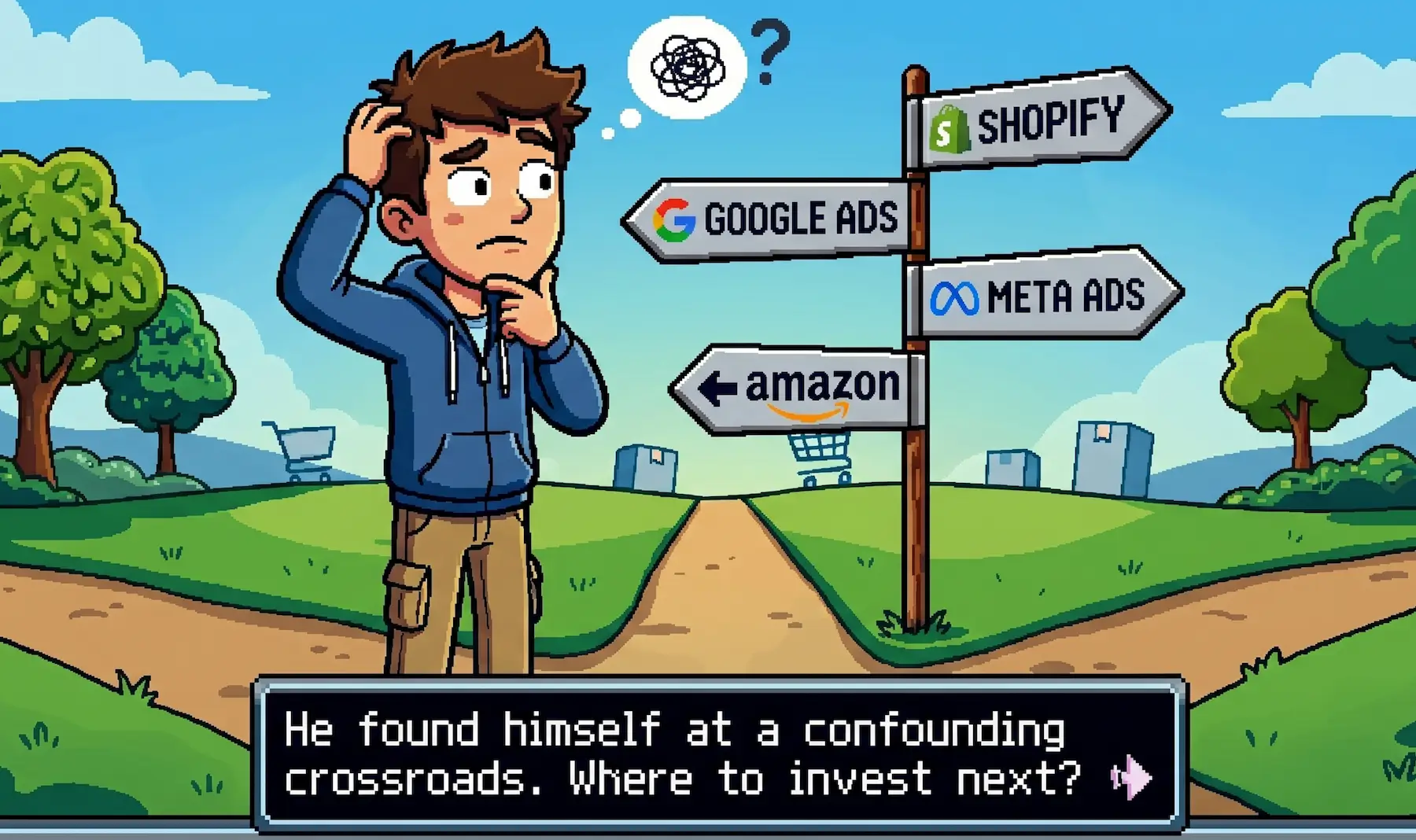
I get this question from ecommerce brands more often than you'd probably guess: "Do you have a way to track sales that originate from Google Ads, then go to Shopify, and then end up purchasing on Amazon?"
It's a fair question.
It's even a great question!
It's just also one of those questions that, in my experience, tends to send well-meaning marketers down a rabbit hole of attribution tools, custom dashboards, and increasingly desperate Slack messages to their analytics person, all in pursuit of a number that, IMO, doesn't actually exist in any reliable form.
So let me just say it plainly: no, but I also don't think anyone does (without spending a WHOLE lot of time and money that is probably not worth it for smaller brands).
Why this problem is actually unsolvable (at least with current tools)
The cross-platform attribution problem (especially when Amazon is involved, which is famously a walled garden) is one of those things you have to learn to live with rather than solve. Amazon doesn't share its purchase data with Google, Shopify can't see what happens after someone leaves the site to "check reviews on Amazon" before buying, and the customer journey itself has gotten so non-linear that even if you could stitch all the data together perfectly, you'd probably still be making directional guesses at the end of it.
This is why at our agency we have learned to focus on directional metrics like MER (Marketing Efficiency Ratio) and contribution margin across all channels to observe patterns over time. We look at it like: "estimate shared costs as much as possible, and then adjust in-platform ROAS targets accordingly... while keeping an eye on the bigger MER picture as the actual primary cost determiner."
From what I've observed, this gets trickier the more channels a brand has running, and at some point you have to make peace with the fact that you're going to be slightly less "efficient" on paper than you'd like if you're wanting to grow through multiple channels. That's not a failure of your analytics setup. That's just the reality of doing modern ecommerce marketing.
But wait... aren't other agencies "solving" this?
No. Other agencies are not solving this (they are "helping guide you to your own truth a little more, not really just taking you to the destination... so perhaps we're more like therapists than airplane pilots"). They are positioning around it.
From what I've observed, the agencies and tools claiming to "solve" cross-platform attribution between Google Ads, Shopify, and Amazon generally fall into one of three buckets:
(1) The MMM (Media Mix Modeling) crowd.
This includes folks like Haus, Recast, Prescient AI, Northbeam, and Triple Whale's MMM offering. These tools use statistical modeling to estimate channel-level contribution across platforms, and they're genuinely useful, THOUGH PRIMARILY for larger brands. But even then, they're not "tracking" anything in the deterministic sense the original question was asking about. They're modeling probabilities based on spend patterns and outcomes, which is a fundamentally different thing (and the good ones, to their credit, will tell you that upfront). The good ones like Olivia Kory at Haus, are doing an incredible job in taking the time to build and analyze complex tests over a period of time. It's just as much art as it is science. But the good ones can genuinely help identify and point you to success here, it's just going to take time and money that is out of reach of the majority of smaller brands (not because they're over-charging, but because of the very point I'm trying to make: this stuff you're asking your PPC agency to solve with one test next month is much much more complex).
(2) The post-purchase survey crowd.
Some brand operators and marketers swear by the PPS (post purchase survey), and the basic idea is asking customers "how did you hear about us?" at checkout and aggregating that data over time. This can be genuinely helpful as a directional input. Directional is doing MAJOR heavy lifting as a word here, since it has its own well-documented issues (recall bias, the fact that customers often genuinely don't remember, and the awkwardness of trying to apply this to Amazon purchases where the brand often can't even reach the customer to ask in the first place).
(3) The "unified attribution platform" crowd.
Be a little careful here, because some agencies and platforms market themselves as having "full-funnel visibility across Google, Meta, Amazon, and beyond," and what they actually mean (if you read the fine print or push them in a sales call) is some combination of MMM, last-click data from each platform, and QUITE the wide confidence interval. I'm not saying they're being dishonest exactly, more that the marketing language is doing a lot of heavy lifting that the technology underneath cannot quite support. Again, this is a very legitimate way of identifying directional success, just walk in eyes wide open with what is happening behind the scenes. In fact, this is where trusting the agency or platform is CRUCIAL, because if you can trust the agency, then their "confidence interval" is more likely to actually be accurate.
The honest agencies in the ecommerce space tend to talk about this problem in roughly the same way I do: directional metrics, MER as the north star, in-platform ROAS as the steering wheel, and a healthy acceptance that perfect attribution is a unicorn nobody's actually capturing. Some of the bigger agencies have built proprietary internal tools to get incrementally better at the modeling (especially based on cross account internal data), which I think is genuinely valuable, though I'd note even those tools are still modeling (Modeling assumes, tracking observes).
Where ZATO fits into all this
So where does that leave us at ZATO, and why am I writing this rather than selling you a fancy attribution dashboard?
A few reasons. First, we're a Google Ads micro-agency, which means we're specialists in one channel rather than generalists trying to be everything to everyone. That focus is part of why I think we're well-positioned to talk about this honestly, because we don't have a financial incentive to sell you a "full-funnel attribution solution". At the end of the day, I want to help your brand be successful across all channels, I see Google Ads as a key part of that, and therefore I want to better understand the actual role Google is playing in serving your Amazon (or really, any incremental!) sales so we can better build for true brand growth (not just Google Ads tracked growth).
Second, our approach is to lean fully into the directional model: we run your Google Ads with in-platform ROAS as the steering wheel, MER as the actual scoreboard, and contribution margin (or, whatever you communicate to us here) as the thing we ultimately care about. We're happy to coordinate with whatever MMM tool or post-purchase survey setup you have running, because those are useful inputs (and we genuinely think they help), though we're not going to pretend they've solved a problem that hasn't actually been solved.
Third (and this is the part I find the most freeing once people accept it), we'd rather have an honest conversation about probabilistic, directional decision-making than sell you a false sense of certainty. From what I've seen, most ecommerce brands are not actually held back by a lack of perfect attribution data, they're held back by a lack of clarity on the data they already have.
The closest thing to a "perfect" test
If you really, truly want to get closer to an answer on the Google Ads halo effect into Amazon, there are basically two paths I'd point you toward:
(1) EXPENSIVE, Bigger Brand Route (higher confidence): Hiring someone like Haus to run expensive, long-term incrementality surveys. This is genuinely worth it once you get big enough and complex enough that the cost of being wrong on attribution outweighs the cost of the study itself, though I'll be honest, most brands I talk to aren't quite there yet. I keep talking about them, because we've worked with them on a client before, and I've chatted personally with Olivia Kory (the owner), and I just think they are the real deal, full stop.
(2) MORE AFFORDABLE, Smaller Brand Route (Lower Confidence): One thing you can try, are some basic holdout tests ("oh cmon Kirk, seriously, holdouts?" Yeah, holdouts... there's a a reason they're popular!): shutting off Google Ads for some key Amazon-listed products for 30 days and watching for drops in Amazon purchase behavior on those specific SKUs, comparing to still-running SKUs, and then turning those products back on and monitoring changes. This can give you directional confidence about the halo effect you're asking about, HOWEVER a big caveat: I'd caution that this should be handled carefully AND MAY NOT SHOW YOU ENOUGH OBVIOUS DATA TO MAKE A DETERMINATION.
In other words, you might run a 30-day blackout test, painstakingly build your spreadsheet, stare at the numbers, and walk away genuinely unsure whether what you're seeing is signal or noise. That's not a fun outcome after spending a month with key products dark on Google, though it's a real possibility I want you to go in with eyes open about.
A better mental model for thinking about this for 7-8 Figure Brands
It seems to me the better mental model is thinking about your marketing efforts as a rising tide that lifts all boats, where your job is to keep adding water without obsessing over which drop ended up in which boat, since trial-and-error at the portfolio level (does MER improve when we lean into Google Ads? does it dip when we pull back?) is usually going to teach you more than any attribution tool ever will. If your brand is too big and you're advertising on too many channels to identify this easily, then that's a clue that it's time to invest in an incrementality service like Haus.
I know that's not the answer most people want. We've been trained by a decade of "data-driven marketing" rhetoric to believe that if we just had the right tool or the right dashboard, we could finally KNOW. The honest truth is that some of the most important questions in marketing don't have clean answers, and pretending otherwise is what gets brands into trouble.
From what I've seen, the brands that win long-term are the ones who get comfortable making decisions based on MER (guided by in-platform ROAS) with imperfect (yet somewhat directional!!) information, while the ones who get stuck are often paralyzed trying to solve a measurement problem that genuinely cannot be solved with the tools we have today, so they just enter this endless loop of "trying to cut spend to save money" and strangling their funnel in the process.
So what should you actually do?
If you're an ecommerce brand running Google Ads and selling on Amazon, my "straight shootin" (I am from Montana near Yellowstone, after all) advice is to stop trying to perfectly attribute the cross-channel journey and start trying to perfectly understand your overall economics. Know your MER. Know your contribution margin. Watch the trends month over month, quarter over quarter. Be willing to test, and be willing to be wrong.
And if you want to dig deeper into how we think about Google Ads strategy for ecommerce at our agency, that's a good place to start.
Perfect attribution is a unicorn. Profitable, sustainable growth is not. I'd rather chase the second one, and I think you should too.


.jpeg)