.webp)
The Philosophy of Google Ads: Why It’s a Demand Capture Channel
At ZATO, one of our core beliefs about Google Ads is that it is primarily a demand capture channel. It’s a distinct way of thinking about search that changes how you approach your entire marketing strategy.
Defining Demand Capture
Here's why this matters: in order for someone to actively search for something (whether they are using a traditional engine like Google or Bing, or an LLM like ChatGPT, Claude, or Gemini) the demand must already exist in their brain. When a user thinks, "Here is something I need to look for," that is existing demand. Your job in Google Ads is to capture that interest, that "existing demand".
This is fundamentally different from demand creation. Channels like Meta, TikTok, or YouTube (and even billboards or taxi placards) are designed to distract the user from their primary intent. If someone is scrolling through a social feed or navigating through New York City, a demand creation ad uses a "thumb stop" to pull them away from what they were originally trying to do. You're literally "distracting them" into interest. You're creating demand from where, previously, there was none.
Google Search and Shopping are different. They are about taking the demand that already exists and convincing the user why your product or service is the right solution.
The Limits of Growth in Google Ads
Here's why this matters: because Google Ads is a subset of advertising (which is a subset of marketing, which is a subset of a business) it cannot control every factor of your growth. It is healthy to communicate that there are real limits to what a PPC budget can achieve.

To scale rapidly, you need factors outside of marketing to be nailed down:
- Finance and Logistics: You must have your product margins and manufacturing sources secured. If you can't keep products in stock, you aren't scaling.
- Product-Market Fit (PMF): Just because you sell laptops and someone searches for laptops doesn't mean you have PMF. If a user wants the Apple loyalty system, you won’t capture them by advertising the cheapest Dell in the universe.
- Targeting and Positioning: You have to have the right offer in front of the right people, such as targeting a corporation that needs 2,000 affordable machines for basic office work.
Maximizing Efficiency within the Cap
What Google Ads does is capture existing demand as efficiently as possible. However, you cannot scale a business past what is possible within the available search or shopping volume. You are limited by your "impression share" (the total amount of available eyes on your market).

To grow revenue within those limits, you have a few levers WITHIN Google Ads:
- Efficiency: You can try to capture more of those existing clicks by improving your click-through rate (CTR) through better ad technology, headlines, or product titles.
- Bidding: You can bid higher to get more exposure, but if you aren't careful, your return on ad spend (ROAS) will decrease and harm your numbers.
- Expansion: You can spend money testing new keywords to find other high-intent searches you haven't bid on yet, though this takes time and expense.
But ultimately, if you want more revenue in Google Ads beyond these three things, you often have to:
- increase demand by leaning into more upper funnel demand creation channels (like Meta or YouTube), or
- increase conversion rate by improving your offer, positioning, sales team, or landing page content.
What many people fail to realize, is that they typically try to solve a demand problem, by pulling levers in the Google Ads account... and thus, never actually "figure out growth in Google Ads", when the path to true growth in Google Ads is relatively easy (in theory): hire a solid practicioner who isn't wasting your money in Google Ads, and then focus on increasing demand and conversion rate elsewhere.
The Danger of the "Bad Practitioner"
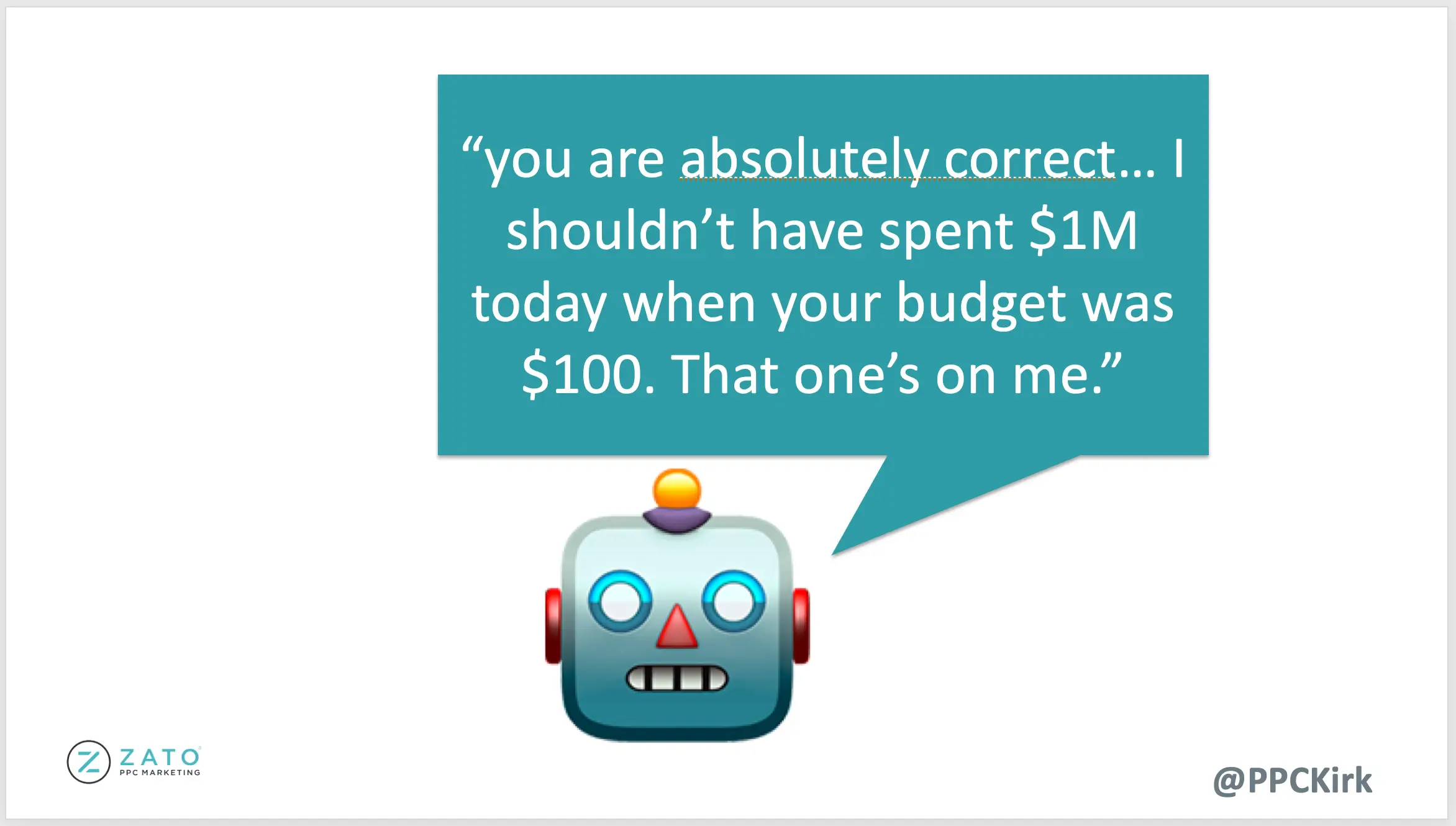
Crucially though, this is why you actually do need a great PPCer at the wheel of your Google Ads ship. Because, while there is a ceiling on how much revenue Google Ads can contribute, there is no limit to the destruction a bad practitioner can cause. I'll put it in terms a 5 year old can understand:
"Money No Easy Come, But Money Easy Go"
A practitioner who doesn't understand the system can run your business into the ground by wasting money on people who aren't your audience. We see this in so many ways, for instance:
- when geo-locations aren't targeted correctly, leading to spend in countries where you can't even sell your product. It also happens when the wrong keyword match types or bidding methods are used.
- when a smart bidding solution like when Target Impression Share is on a brand search campaign without a Max CPC cap. Google may overbid for impressions just to "win," even if those sales aren't worth the higher auction cost. A good practitioner knows when to use a manual bid or a cap to get the same sales for much cheaper.
All this to say, in defining the Google Ads Search & Shopping system as primarily "demand capture" it certainly doesn't eliminiate the need for skilled experts, as the old adage is true "if you think an expert is expensive, just wait until you hire an amateur Google Ads manager."
Conclusion: Hiring for Philosophy
Google Ads is a healthy, vital part of your business, but it has inherent limitations on how much it can scale. This is why the right philosophy is a crucial thing to look for when hiring a PPC agency or person, because the right philosophy drives the right campaign decisions.


.jpeg)