.webp)
Did you know Microsoft Ads offers impression-based remarketing audiences? You don’t have to have someone visit your site in order to show them a remarketing ad. All the user has to do is view your ad, and you can show them another - either across the audience network or by bidding higher for their second view with audiences across search.
Benefits of Impression Based Remarketing
Some of the benefits of utilizing Impression Based Remarketing involve the ability to target users at each stage of the funnel with precision, by targeting them based on previous ad exposure as well as aligning your creatives with their funnel stage.
This product is best suited for a business model with a longer path to purchase, though Microsoft indicates here that a consumer typically needs to see an ad 7–8 times in order for it to achieve a “meaningful impact.” This would also usually be originating over a 30-day period, based on the “Rule of 7.” In fact, because this article was from 2024, it could be argued we may be closer to 9 or 10 impressions per month, as our attention has become even more fragmented over the last 2 years.
What is Microsoft's Impression Based Remarketing?
Impression-based remarketing in Microsoft works by creating an audience list made up of people who have seen your ads on Microsoft. You can create it by choosing up to 20 eligible campaigns or ad groups in your account that you want to use impressions from. Microsoft will use first-party ad data to automatically generate that audience based on the unique impressions the campaign receives.
How do you set up Impression Based Remarketing?
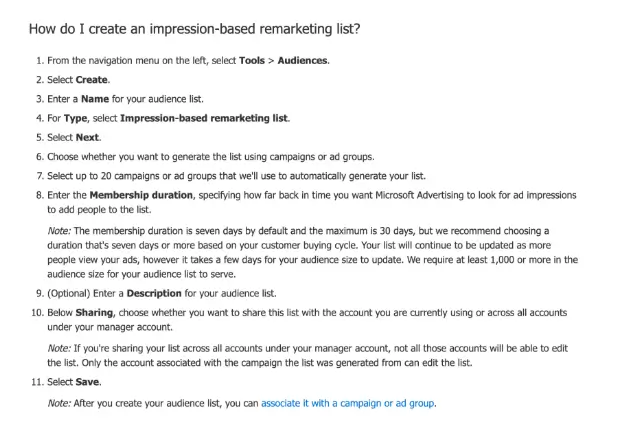
Microsoft has an excellent step-by-step guide on how to create impression-based remarketing lists in this support article: Impression-based remarketing: Reach people who have viewed your ads.
How do you use an Impression Based Remarketing Audience?
Once you have your impression-based remarketing list populated, there are a couple of ways you can go about utilizing it.
- Top of Funnel
- Run a campaign either via CTV, Video, or through the Microsoft Audience Network to build brand awareness. Use this campaign to generate your list.
- Target users on this list with search or shopping ads, featuring specific CTAs, discounts, or social proof.
- Search Audience Bid Adjustment
- Use your impression-based list in your primary search campaign with a positive bid adjustment to bid more aggressively for ads on high-intent searches.
- Cross Channel
- Use impressions from a broad search campaign to build your audience list.
- Re-engage this audience through native feeds with visual image assets within the Audience Network.
- Exclusions
- If you run aggressive display or video campaigns on Microsoft, set your impression membership window to 3-7 days.
- Exclude that audience so you don’t over-saturate the same user with your top of funnel ads.
Best Practices for using Impression Based Remarketing Lists
The default membership duration is usually 7 days, but you can select a maximum of 30 days. It is recommended to keep the window short to ensure you are targeting users while brand recall is high. Keep in mind that Microsoft requires at least 300 users in an audience list before it can be used actively in campaign optimizations, so make sure that your source campaign can generate this quantity of users in order to utilize impression-based remarketing.
Conclusion
As zero-click searches become more common, utilizing impression-based remarketing will become increasingly important to capture a searcher’s attention. By targeting users who have seen your ad - even without clicking through - you can generate greater exposure for your brand and drive additional website visitors. When users repeatedly encounter your brand messaging across their online touchpoints, trust builds naturally, keeping your business top-of-mind when they are finally ready to convert. Ultimately, leveraging these visual and contextual impressions bridges the gap between passive awareness and active engagement, ensuring you capture maximum value from every SERP impression.